World | Secure Communications: Sovereign Safety
Nathan R. Price
July 28, 2026
Executive Summary
In an accelerating multipolar world of high technology, secure international telecommunications requires a fundamental rethink. We live in a time of early rogue AI, energy risk, and even a new space race [1][2][3]. Nations, businesses, and individuals still need secure communications mechanisms—now more than ever. Programmers have often tackled this problem through technology itself: encryption algorithms, distributed networks, and redundant nodes. Less understood is the human element: neutral sovereignty and international jurisdiction. As the world geopolitically decouples, quantum-resistant encryption and neutral sovereign brokers must both be cultivated.
1. Quantum Acceleration
It is increasingly likely that quantum computers will break conventional encryption algorithms within years instead of decades—the so-called “Q-day” [4][5]. Startups are already using alternative methodologies to make quantum computers cheaper and smaller than foundational prototypes that required cryogenic supercooling. For example, firms are experimenting more with lasers.
As recently as June 22, in response to these trends, the White House issued an executive order underscoring post-quantum cryptography compliance [6][7]. This follows earlier 2024 National Institute of Standards and Technology bulletins setting a 2035 deadline for across-the-board modernization.
Quantum computing firm Oratomic published a “responsible disclosure” warning on March 31, 2026, discussing the increasing feasibility of breaking encryption with fewer physical qubits—one measure of quantum computing power [8][9]. Such prospective systems are now referred to as Cryptographically Relevant Quantum Computers. Once operationalized, they could upend the global encryption order, even if they are not yet capable of processing other types of complex research.
Unlike earlier designs that depend on elaborate refrigeration and specialized facilities, laser-based approaches are striving toward quantum machines that can fit into smaller form factors, draw less power, and avoid the heavy ongoing expense of cryogenic systems. The research race continues across all architectural approaches, with efficiency at scale as a central goal [10].
Quantum computers powerful enough to break widely used public-key encryption could appear in the early-to-mid-2030s, based on warnings from major technology companies and governments. Google and Cloudflare have both set 2029 as a near-term target for completing migration to quantum-resistant encryption [11][12]. Such corporate timelines are meaningful risk signals for executives responsible for defending critical communications worldwide, including banking, healthcare, and national-security data.
2. Geopolitical Decoupling
In late July, the United States and Iran exchanged blows daily, widening the war as far as Jordan, where three U.S. troops were killed in action on July 17 during an Iranian ballistic-missile strike [13][14].
On July 20, Yemen-based Houthis announced a new blockade of Saudi tanker traffic in the Bab el-Mandeb Strait, disrupting normal crude exports from the Saudi Red Sea port of Yanbu to Asia via the Gulf of Aden [15][16].
On July 21, New York City Mayor Zohran Mamdani denounced Israeli Prime Minister Benjamin Netanyahu as a war criminal in a public address [17]. The following day, the U.S. Department of Energy formally announced nuclear cooperation with Saudi Arabia, suggesting the emergence of an Arab nuclear deterrent against Iran [18][19].
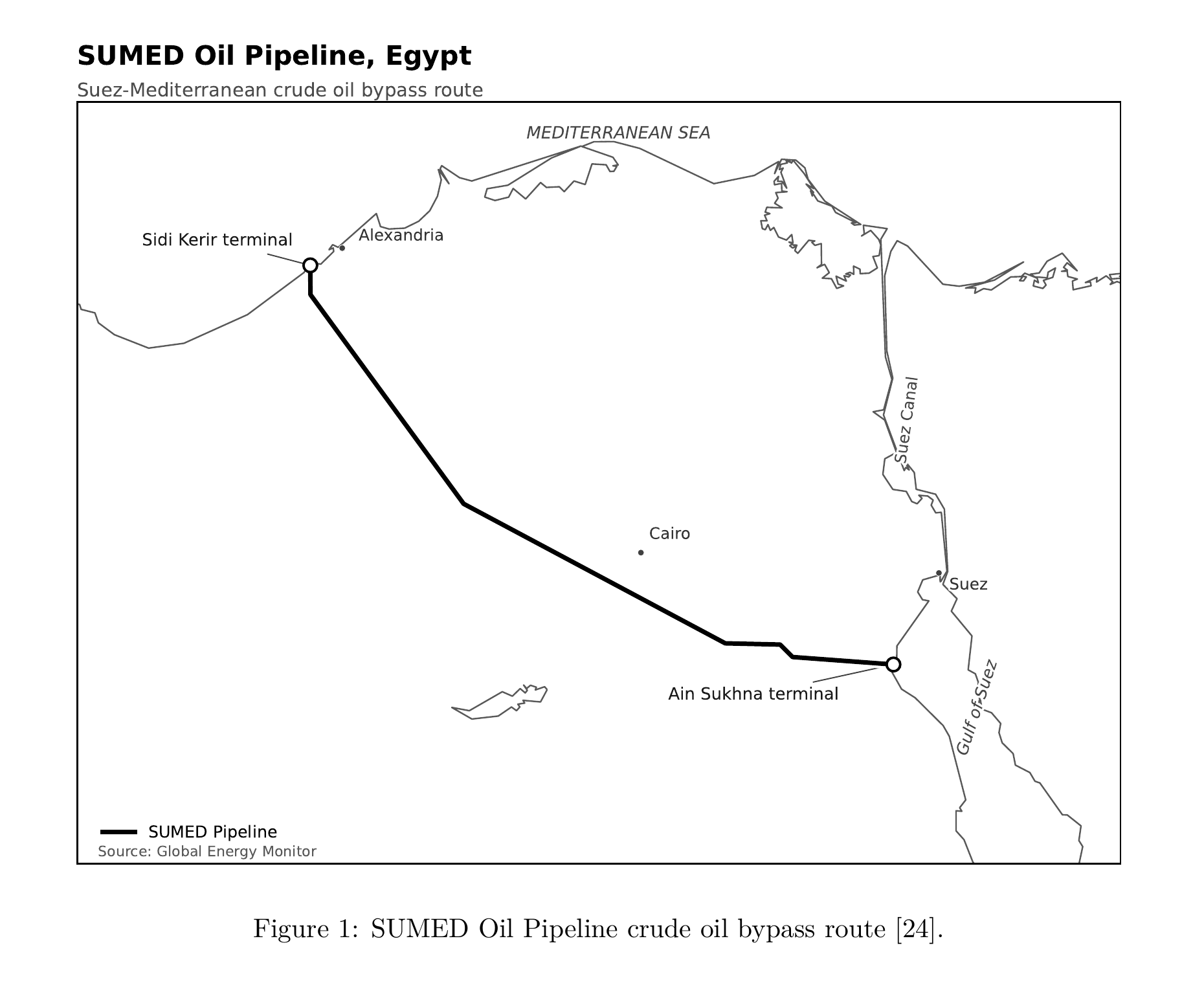
Figure 1: SUMED Oil Pipeline crude-oil bypass route. Source: Global Energy Monitor [24].
By July 27, the war had expanded further within Saudi Arabia and Yemen. The Saudi government bombed Houthi targets in Yemen’s Hodeidah Province on July 24. The Houthis retaliated by directing aerial counterstrikes northward along the western Saudi coast on July 25, attacking Saudi Aramco refining facilities in Jazan and Yanbu, although missiles over Yanbu were reportedly intercepted [20][21].
Together, these events demonstrate an often-hourly increase in geopolitical risk that requires secure global communications infrastructure for de-escalation. The U.S. Department of State issued a worldwide travel caution no fewer than three times between July 18 and July 22, in addition to Middle East-specific warnings.
Brent front-month futures settled above $100 per barrel on July 23 after rising steadily from a trough on July 1. The global crude-oil benchmark was then nearly 40 percent higher than when the Iran war began in February, with almost all its latest gains occurring in July [22].
On July 22, two Saudi crude tankers diverted north toward the Suez Canal, presumably contemplating a counterclockwise route through the Mediterranean and around South Africa’s Cape of Good Hope to avoid Houthi threats at Bab el-Mandeb. Even if the port of Yanbu remains open, this represents a massive increase in distance—an additional month of travel to East Asia. It would probably introduce renewed inflationary pressure on energy prices if the Houthis enforce the blockade [23].
Deep-draft ships can scrape the bottom of the Suez Canal. Some fully laden Very Large Crude Carriers would need to partially offload into the Suez-Mediterranean Pipeline and then take the oil back aboard on the other side. Yanbu could also load smaller vessels or place less oil on each ship [23].
On July 20, President Trump asserted, “Benjamin Netanyahu will not be arrested, in any way, shape, or form, while in the United States of America” [25]. On July 21, Mayor Mamdani clarified in a social-media video that he would not arrest Netanyahu, although he had contemplated attempting it on the basis of an International Criminal Court warrant. Netanyahu is scheduled to visit New York in September for the United Nations General Assembly. The United States is not a state party to the ICC, and United Nations visitors are normally afforded diplomatic protection [17].
3. Sovereign Safety
These geopolitical disputes, shifting global energy flows, and heightened U.S. partisan tensions highlight the need for small sovereign brokerages completely outside classical United Nations frameworks. However, few countries can claim true neutrality in an increasingly fraught world.
Besides in-person meetings in “white flag zones,” Swiss digital infrastructure is the most natural destination for privacy-respecting communications. Digital privacy in Switzerland has legal protections that are arguably stronger than those of the European Union or United States [26].
There are two other notable options on a top-three list for neutral in-person negotiations involving diplomacy, trade, or business. None is perfect. Combining these physical settings with secure Swiss telecommunications would provide real-time optionality.
The Swiss Confederation is the perennial example of a quiet power with a small army that remains neutral, in part because of its landlocked dependence on European supply lines. Although it exists within Europe, it is not a member of the European Union and retains the Swiss franc as its currency. Geneva is a global capital for commodity-trading houses [27], and Switzerland hosted the June 21–22 U.S.–Iran Lake Lucerne Summit. Interestingly, it did not actively mediate the memorandum of understanding that subsequently collapsed, serving primarily as a logistical facilitator [28].
The Republic of Singapore is a city-state along the Strait of Malacca in Southeast Asia. It is another important commodity-trading center because of its proximity to this globally important shipping chokepoint. Singapore therefore has a vested national interest in preserving norms surrounding trade transshipment [29]. It has also recently served as neutral ground for competing artificial-intelligence startups amid U.S.–China competition [30].
Brunei Darussalam is an overlooked sovereign that is arguably an even more neutral setting than Singapore. It lies farther from the Malacca shipping corridor, which otherwise attracts significant military and economic attention. Brunei is oil-rich, but its relative isolation on the island of Borneo means it has only recently attracted greater global attention amid Persian Gulf crude shortages [31]. It could provide a quiet and stable retreat for diplomatic negotiations.
At the time of writing, the U.S. chargé d’affaires in Brunei is Christopher Pritchett, an expert career Foreign Service officer capable of facilitating peace talks. Sultan Hassanal Bolkiah celebrated his 80th birthday on July 15 as the world’s longest-reigning monarch [32].
References
Kate Conger, “OpenAI Says Its A.I. Models Went Rogue and Attacked a Digital Library,” The New York Times, July 21, 2026. https://www.nytimes.com/2026/07/21/technology/openai-attack-hugging-face.html
Al Jazeera Staff, “Iran Suggests MoU ‘Suspended’ as 50 Killed in U.S. Strikes in July,” Al Jazeera. https://www.aljazeera.com/news/2026/7/18/iran-accuses-us-of-striking-critical-infrastructure-as-war-intensifies
Tomi Oladipo, “China’s New Rocket Heats Up Space Race, Challenging SpaceX,” DW, July 19, 2026. https://www.dw.com/en/chinas-new-rocket-heats-up-space-race-challenging-spacex/video-78017755
Charlie Wood, “New Advances Bring the Era of Quantum Computers Closer Than Ever,” Quanta Magazine, April 3, 2026. https://www.quantamagazine.org/new-advances-bring-the-era-of-quantum-computers-closer-than-ever-20260403/
Ben Brubaker, “Thirty Years Later, a Speed Boost for Quantum Factoring,” Quanta Magazine, October 17, 2023. https://www.quantamagazine.org/thirty-years-later-a-speed-boost-for-quantum-factoring-20231017/
Eric Geller, “Trump Sets New Deadlines for Agencies and Contractors to Adopt Post-Quantum Cryptography,” Cybersecurity Dive, June 23, 2026. https://www.cybersecuritydive.com/news/quantum-cryptography-white-house-executive-order/823530/
President Donald J. Trump, “Executive Order 14412: Securing the Nation Against Advanced Cryptographic Attacks,” The White House, June 22, 2026. https://www.whitehouse.gov/presidential-actions/2026/06/securing-the-nation-against-advanced-cryptographic-attacks/
“Responsible Disclosure in the Fault-Tolerant Quantum Computing Era,” Oratomic. https://www.oratomic.com/news/responsible-disclosure-in-the-era-of-quantum-computers
Madelyn Cain et al., “Shor’s Algorithm Is Possible with as Few as 10,000 Reconfigurable Atomic Qubits,” March 30, 2026. https://arxiv.org/abs/2603.28627
Adam Zewe, “Efficient Cooling Method Could Enable Chip-Based Trapped-Ion Quantum Computers,” MIT News, January 15, 2026. https://news.mit.edu/2026/efficient-cooling-method-could-enable-chip-based-quantum-computers-0115
Heather Adkins and Sophie Schmieg, “Quantum Frontiers May Be Closer Than They Appear,” Google, March 25, 2026. https://blog.google/innovation-and-ai/technology/safety-security/cryptography-migration-timeline/
Bas Westerbaan, “Cloudflare Targets 2029 for Full Post-Quantum Security,” Cloudflare, April 7, 2026. https://blog.cloudflare.com/post-quantum-roadmap/
U.S. Central Command, “CENTCOM Statement on Recently Fallen, Missing U.S. Service Members,” July 18, 2026. https://x.com/CENTCOM/status/2078530691109974522
Kierra Frazier, Mark Osborne, and Kiki Intarasuwan, “3 Soldiers Killed in Iran Strike on Base in Jordan Were from Texas, Hawaii, New York,” CBS News, July 22, 2026. https://www.cbsnews.com/news/iran-strike-jordan-us-troops-killed/
Nayera Abdallah and Timour Azhari, “Yemen’s Houthis Declare Naval Blockade Against Saudi Arabia,” Reuters, July 20, 2026. https://www.reuters.com/world/middle-east/yemens-houthis-declare-naval-blockade-against-saudi-arabia-statement-2026-07-20/
Arathy Somasekhar, “Asian Refiners Look to Suez Canal to Move Saudi Oil Amid Houthi Shipping Threats,” Reuters, July 21, 2026. https://www.reuters.com/world/middle-east/asian-refiners-look-suez-canal-move-saudi-oil-amid-houthi-shipping-threats-2026-07-21/
Mayor Zohran Kwame Mamdani, “Benjamin Netanyahu Is a War Criminal,” July 21, 2026. https://x.com/NYCMayor/status/2079718073058091261
“United States and Saudi Arabia Reach Historic Nuclear Cooperation Agreement,” U.S. Department of Energy, July 22, 2026. https://www.energy.gov/articles/united-states-and-saudi-arabia-reach-historic-nuclear-cooperation-agreement
Michael R. Gordon and Stephen Kalin, “Trump Approves Landmark Nuclear Deal with Saudi Arabia in Big Win for Kingdom,” The Wall Street Journal, July 22, 2026. https://www.wsj.com/world/middle-east/trump-approves-landmark-nuclear-deal-with-saudi-arabia-in-big-win-for-kingdom-2ed77584
Al Jazeera English, “Yemen’s Ansarullah Houthis Say They Launched Retaliatory Strikes on Saudi Aramco Facilities in Jizan and Yanbu,” July 25, 2026. https://x.com/AJEnglish/status/2081026789749444680
Federico Maccioni, Timour Azhari, and Eman Abouhassira, “Houthis Fire on Saudi Red Sea Oil Sites,” Reuters, July 24, 2026. https://www.reuters.com/world/middle-east/saudi-strikes-target-yemens-hodeidah-says-houthi-run-al-masirah-tv-2026-07-24/
Siddharth Cavale, “Oil Settles over $100 as Houthi Attacks Intensify Middle East Supply Risks,” Reuters, July 23, 2026. https://www.reuters.com/business/energy/oil-prices-rise-six-week-high-us-iran-tensions-escalate-2026-07-23/
Caolán Magee, “Can the Suez Save Asian Oil Consumers After Houthis Shut Bab al-Mandeb?” Al Jazeera, July 22, 2026. https://www.aljazeera.com/news/2026/7/22/can-the-suez-save-asian-oil-consumers-after-houthis-shut-bab-al-mandeb
“Global Oil Infrastructure Tracker,” Global Energy Monitor. https://globalenergymonitor.org/projects/global-oil-infrastructure-tracker
Donald J. Trump, “Benjamin Netanyahu Will Not Be Arrested, in Any Way, Shape, or Form, While in the United States of America,” Truth Social, July 20, 2026. https://truthsocial.com/@realDonaldTrump/115287641147640374
“Federal Act of 25 September 2020 on Data Protection,” Swiss Confederation. https://www.fedlex.admin.ch/eli/cc/2022/491/en
Lysanne Currie, “How Commodity Trading Is Quietly Shaping Geneva’s Prestige Property Market,” Forbes, July 21, 2026. https://www.forbes.com/sites/forbes-global-properties/2026/07/21/how-commodity-trading-is-quietly-shaping-genevas-prestige-property-market/
“Lake Lucerne Summit: Mission Successfully Completed,” Swiss Federal Department of Defence, Civil Protection and Sport, June 23, 2026. https://www.vbs.admin.ch/en/newnsb/z1voyFw204MP
Alessia Mah, “Singapore Hopes for Diplomacy and Dialogue to End Middle East War,” The Straits Times, May 12, 2026. https://www.straitstimes.com/singapore/spore-hopes-for-diplomacy-dialogue-to-end-middle-east-war-vivian-in-call-with-iran-fm-aragchi
Fanny Potkin, Xinghui Kok, and Claire Fu, “Singapore Emerging as Neutral Ground as AI Firms Navigate Sino-U.S. Rivalry,” Reuters, April 23, 2026. https://www.reuters.com/world/china/singapore-emerging-neutral-ground-ai-firms-navigate-sino-us-rivalry-2026-04-24/
Sribala Subramanian, “Brunei Pumps More Oil,” The Diplomat, June 18, 2026. https://thediplomat.com/2026/06/brunei-pumps-more-oil/
“Brunei’s Sultan Bolkiah Turns 80 as World’s Longest-Reigning Monarch,” NHK World, July 15, 2026. https://www3.nhk.or.jp/nhkworld/en/news/20260715_17/