Next Steps for Foreign Assistance Reform
By Joanna Snearly
August 7, 2026
The second Trump administration has made unprecedented progress in reforming foreign assistance in the U.S. Department of State. The elimination of many wasteful programs, the consolidation of USAID into the Department, and a reorganization have established a strong foundation for a foreign-assistance system aligned with U.S. foreign-policy goals. This more disciplined use of public funds has increased accountability to the American people. As a next step, a more streamlined administrative structure for federal-assistance programs—including grants and cooperative agreements—would support this new foundation.
In July 2025, Senate Foreign Relations Committee Chairman James Risch described the Department’s reorganization as a “good start” and “first step” toward a more effective foreign-policy organization. (Risch Opening Statement at State Department Reform Hearing)
The Department’s FY 2026 Congressional Budget Justification further establishes the basis for continued reform. The document states the Department’s intention to streamline programs and operations, improve efficiency, align resources with national interests, and complete the integration of selected USAID programs and management resources. The request identifies targeted staffing increases as necessary to ensure that Department bureaus possess the capacity and expertise required to implement and oversee transferred programs.
It also states that the Department will review and integrate foreign-assistance design, monitoring, evaluation, training, and related support mechanisms as it assumes additional programming responsibilities. It separately commits to improving foreign-assistance data quality, transparency, and accuracy throughout the data lifecycle.
The budget justification says that integrating assistance functions into State is intended to improve “efficiencies” and enhance “efficiency, accountability, uniformity, and strategic impact.” It criticizes overlapping mandates, blurred reporting lines, duplication, excessive processing time, and the involvement of too many individuals. (U.S. Department of State, FY 2026 Congressional Budget Justification)
The need for continued improvement was also identified in the Department’s May 2025 Office of Inspector General report, Evaluation of the Department of State’s Approach to Realigning U.S. Agency for International Development Functions, AUD-GEER-25-20.
The OIG recommended permanent senior-level accountability, an evaluation of the Department’s workforce capacity, and completion of an implementation plan, among other measures. (AUD-GEER-25-20, Recommendations 1–3)
The July 2026 OIG follow-up report, Evaluation of Department of State Administration of Foreign Assistance Programs Transferred from the U.S. Agency for International Development, AUD-FA-26-17, recognizes resolutions pending further action. It also documents the scale and complexity of the Department’s new responsibilities.
Seventeen bureaus and offices were responsible for 1,504 transferred programs and associated awards, with $51.5 billion obligated and an expected cost exceeding $86 billion across approximately 100 countries. OIG identified continuing problems involving staffing, personnel training, access to information-technology systems, award guidance, and the completeness and accessibility of award data. OIG concluded that these conditions negatively affected the Department’s ability to administer the transferred programs effectively and efficiently. (AUD-FA-26-17)
OIG further found that Department organizations were developing different operating arrangements. Seven of the 16 responding entities planned to manage transferred awards differently from their existing Department awards. Other entities planned varying combinations of Washington-based personnel, regional-assistance hubs, overseas posts, Bureau of Global Acquisitions grants officers, and locally employed staff.
These differing approaches create a risk of inconsistent procedures, uneven workloads, duplicative functions, and unclear administrative accountability.
Recent Government Accountability Office reporting illustrates the need for reliable Department-wide data and portfolio visibility. In a June 2026 review of approximately 470 State and USAID projects, GAO found that officials lacked readily available and reliable information about the projects’ types and status.
Information had to be requested from separate bureaus and overseas posts and compiled from multiple sources, resulting in incomplete data and errors. GAO recommended maintaining complete and periodically updated information identifying award numbers, responsible bureaus or posts, geographic locations, timeframes, funding, and strategic purpose. (Countering China: Agencies Provided Over $1 Billion but Have Not Assessed Overall Results of Projects, GAO-26-107822)
In March 2026, GAO identified weaknesses involving fraud-awareness training, screening and vetting, and oversight of subawardees. (Foreign Assistance: Opportunities Exist for Agencies to Improve Their Management of Fraud, Waste, and Abuse Risks, GAO-26-108945)
A practical approach to more effective grants management would be to further centralize the management controls and specialized support required to execute foreign-assistance programs. Consolidating repeatable functions in a central office would reduce duplicative efforts at the bureau level.
Housing grants-management expertise in one office would allow the Department to deploy staff where they are most needed, give leadership a clearer view of the overall portfolio, and apply consistent data standards, risk controls, and administrative practices across bureaus. Regional and functional bureaus would retain responsibility for program design, conception, technical expertise, and foreign-policy objectives while sharing the monitoring function with centralized administrative experts.
The current Foreign Affairs Manual assigns the Bureau of Global Acquisitions responsibility for centralized federal-assistance policy, training, and oversight. It assigns the bureau’s Federal Assistance Management organization responsibility for executing shared-services federal-assistance and grantmaking operations. (1 FAM 350, §§ 354–355.)
The Department should therefore designate the Bureau of Global Acquisitions’ Federal Assistance Management organization as the centralized provider of all administrative grants-management services for Department federal-assistance programs, including grants, cooperative agreements, and other federal-assistance instruments.
Building upon the bureau’s existing responsibilities, rather than establishing a duplicative organization, would allow the Department to use an existing management structure.
Centralization would permit Federal Assistance Management to establish and strengthen its operational capacity and functional support:
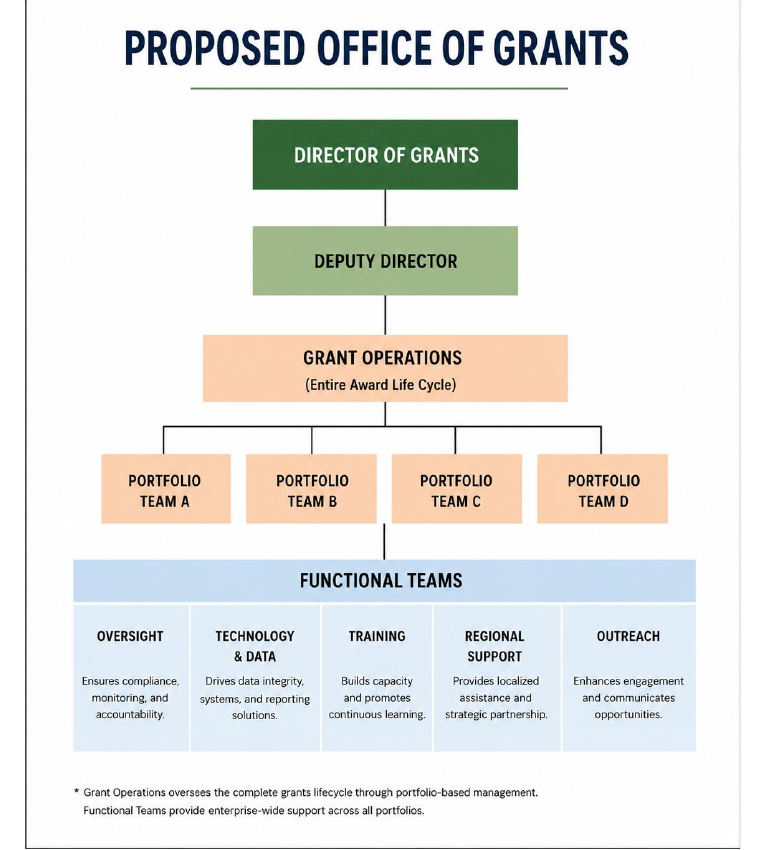
The Department needs one accountable operating structure for the administrative work presently distributed across multiple bureaus, offices, and posts.
The Bureau of Global Acquisitions is the appropriate location because the Department has already assigned it the relevant Department-wide responsibilities. Formally designating the bureau as the administrative service provider for all foreign-assistance awards would complete the existing structure rather than create a new or competing organization.
The proposed organizational structure combines centralized accountability with portfolio-based services. Portfolio teams would provide regional and functional bureaus with dedicated grants-management support throughout the award lifecycle. Common functional capabilities would establish uniform data, workforce, IT systems, risk analysis, training, and field-support practices across those portfolios.
Grants personnel could remain embedded with bureaus, regional hubs, and overseas posts where operationally necessary, while their professional supervision, standards, systems, and workload management would reside in the Bureau of Global Acquisitions.
Centralization would also give Department leadership a single accountable source for all Department grant portfolios. Leadership would be able to identify who is responsible for each award, which recipients and awards present elevated risk, whether required monitoring has occurred, whether award data are complete, and whether findings and closeouts remain unresolved.
A centralized administrative structure would provide leadership with consistent access to awards and greater visibility into Department programs.