Zed Tarar
April 14, 2026
How the Foreign Service learned the wrong lesson from the right case—and what the Army figured out instead.
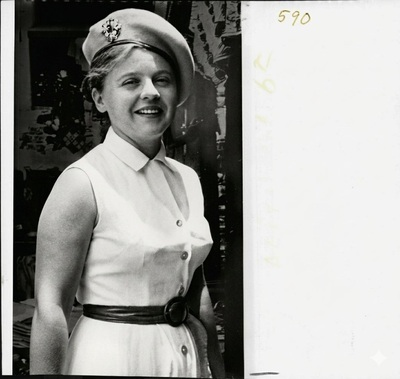
Alison “Tally” Palmer, U.S. Foreign Service Officer, c. 1962. Source: Internet Archive/press photo.
It’s the dry season, and Tally Palmer is taking advantage of it by driving her silver convertible to the airport. The roads are barely paved, and there are soldiers everywhere, but at least the humidity is low. Some of her colleagues had evacuated, yet Tally, never one to shy away from danger, asked to stay behind at the embassy.
The country is in chaos. Riots in the streets, defections in the army, and provinces declaring independence. Foreign governments can’t evacuate their citizens fast enough. On her way to the airport, Tally spots an embassy car by the roadside and sees a colleague on the ground. Another is surrounded by a mob. She spots a machete in the crowd.
Moments earlier, Tally’s colleague, Frank Carlucci, was wrapping up a senior official’s visit to the capital. He was trailing the official motorcade heading to the airport. It’s July 1960, and the State Department had dispatched its troubleshooter to Leopoldville to try to make sense of the situation. It had taken merely two weeks after independence from Belgium for Congo to plunge into violence. Frank was helping Loy Henderson, the U.S. ambassador to Iran, get warring factions to stand down.
Frank looked over at the embassy’s young warrant officer, behind the wheel, driving fast. Too fast.
“Hey, slow down,” Frank said.
The defense attaché and his wife were in the back seat. A bicycle veered in front of them, and Frank knew from the moment of impact that the cyclist was dead. They swerved into a ditch. Frank knew what would happen next—a mob looking for vengeance.
The attaché’s wife looked to be in shock. Frank jumps out and stands next to the lifeless cyclist in the center of the growing crowd. The warrant officer gets the attaché and his wife away from the car but is stabbed in the process; he’s on the ground.
Tally knows help isn’t coming. She spots the warrant officer and drives her silver convertible through the crowd. Bystanders throw him into her back seat. Frank sees her and knows she can’t get to him.
“Tally, get out of here!” he yells.
She speeds off. The crowd grows increasingly agitated around Frank. A bus hurtles toward him. The driver pushes through and opens the back door. Frank steps in. It’s only later that he sees the pool of blood and realizes he’s been stabbed.
Alison “Tally” Palmer and Frank Carlucci were later recognized by the State Department for their work during what became known as the Congo Crisis.

Military police patrol the streets of Leopoldville following Congolese independence, July 1960. Wikimedia Commons/public domain.
Frank went on to have a stellar career. Tally, the five-foot, blue-eyed blonde with a reputation for being fearless, spent the late sixties in harm’s way in Vietnam during the height of hostilities.
Her career, though, was held back. Three separate U.S. ambassadors at African posts refused her assignment requests, citing concerns about harassment from host-government officials. She was passed up for promotion. Never one to back down, she filed the first equal-employment-opportunity complaint ever heard by the Foreign Service in 1968.
Three years later, she won, getting her promotion and back pay. She used that money to launch a class-action lawsuit against the department in 1976. It would take 34 years to resolve the case.
Over the course of the Palmer litigation, courts found discrimination in assignments, promotions, and awards—and found that the Foreign Service exam had a disparate impact on women.
The solution should have been obvious: Remove subjectivity from these processes and make them blind to the applicant’s immutable characteristics. That’s exactly what Olivier Sibony and Daniel Kahneman found in their groundbreaking work in Noise.
Most have a sense of what “bias” means in the context of employment. It’s what Tally Palmer faced in the sixties. Her own assignments officer wrote to an ambassador that he might be “surprised that we would consider sending a girl to Addis.”
Noise is a trickier concept, but it is the flipside of the same coin. If we think of good decisions as hitting a bullseye, then bias is like seeing all the shots clustering off-target in the same direction. Noise is a random scatter—a few make it close, but not reliably.
Sibony and Kahneman write, “The uniqueness of people’s personalities is what makes them capable of innovation and creativity... When it comes to judgment, however, that uniqueness is not an asset.”
But the State Department did something strange in the Palmer case. It did the opposite. It removed the one aspect of the Foreign Service selection process that was blind to immutable characteristics—passing the written exam—and added more subjectivity.
In 2007, under a court order to remove bias, the department added the Qualification Evaluation Panel, an opaquely named and governed body. Passing the exam was no longer enough to be invited to the Oral Assessment phase—your résumé and essay questions had to look “right.”
Another 15 years would go by before the written exam was made optional. The institution learned the wrong lesson from the right case.
Mandarins and Marines
Sixty years after Palmer’s case, another arm of the U.S. government faced the same question—and reached the opposite conclusion.
Defense Secretary Mark Esper can’t believe what he’s hearing. It’s July 2020, and his Cabinet agency is using photos in personnel packets. Promotion panels not only have identifying characteristics in files but are further swayed by a person’s appearance.
We know from decades of empirical evidence that people are influenced by the halo effect, in which someone’s appearance shapes how others perceive their character. The square-jawed Marine stereotype.
It’s something Chinese bureaucrats knew hundreds of years ago. The famously difficult exam to become an imperial official, later dubbed “Mandarin” by Western observers, was meant to find the brightest talent regardless of background. Examiners employed scribes to rewrite answer sheets, anonymizing the papers to remove bias—and to remove noise.
Sibony and Kahneman document this well—the more superfluous information is injected into a decision-making process, the higher the likelihood of noisy results. A study found judges were more lenient when they knew they were hearing a case on a defendant’s birthday.
On September 24, 2020—peak COVID, virtual format—Secretary Esper, Joint Chiefs Chairman General Mark Milley, and Senior Enlisted Advisor Ramón Colón-López took questions from service members in a livestreamed town hall.
Milley was blunt: “We are the world’s biggest meritocracy... To do that, we have to essentially sterilize the board files.”
The Army’s own researchers had already tested the idea and found that when photos were removed, scorers agreed more and took less time per file. Colonel Carl Wojtaszek put it in terms Kahneman would recognize: “The photo is introducing more noise than signal about the officer’s talent.”
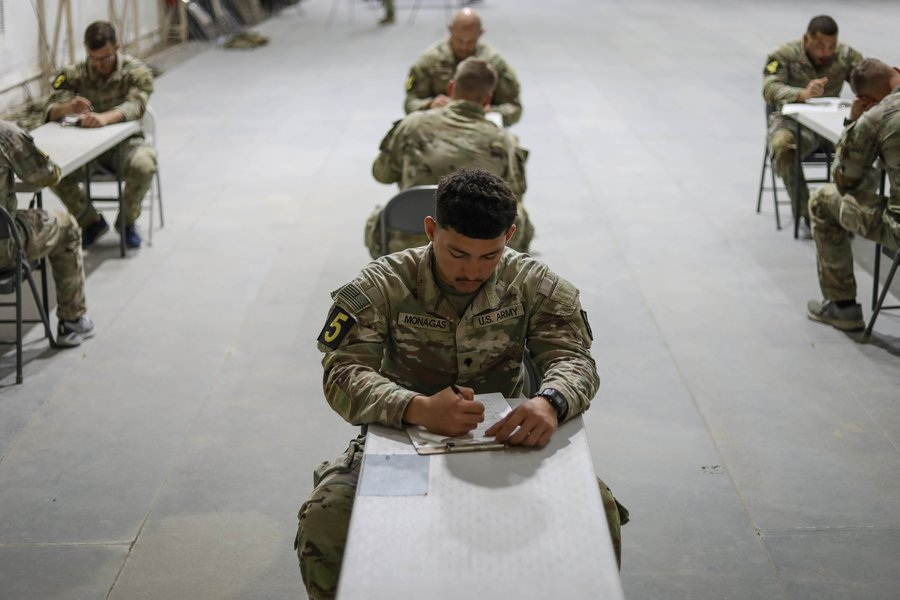
U.S. Army soldiers complete a written examination. Research showed that removing photos from promotion packets increased scorer agreement and reduced evaluation time. DVIDS/U.S. Department of Defense/public domain.
The Defense Department went further—not just photos but all identifying characteristics: race, gender, age, everything.
Did it work? A RAND Corporation study published in December 2023 found that the promotion-rate gap between white and minority officers narrowed after the policy change, particularly at the rank of major, where the gap essentially went to zero.
A separate RAND study of the Air Force found that when comparing officers with similar records, minority officers were promoted at the same rate 93 percent of the time—the disparity was in who got into the competitive pool, not what happened at the board.
The strongest objection to blind selection is that bias doesn’t happen at the promotion board—it happens upstream, in mentorship, assignments like the ones Tally Palmer was denied, and performance evaluations.
That objection deserves to be taken seriously. But the answer is to fix the pipeline, not to corrupt the endpoint. A selection process that considers race doesn’t undo the effects of unequal mentorship; it just shifts the distortion to a different stage. The concern about representation is legitimate. The method is wrong.
Seventy-Seven Cents
Women earn 77 cents to the dollar of a man’s wage, or so the saying goes. But is it true?
Claudia Goldin, a Harvard economist, was awarded the Nobel Prize in Economics in 2023 for her work answering this question. Her key finding: When you account for the types of work men and women do, the wage gap largely disappears.
In her landmark 2014 paper, she wrote that the gender gap “would be considerably reduced and might vanish altogether if firms did not have an incentive to disproportionately reward individuals who labored long hours and worked particular hours.”
A study of MBA graduates drove the point home: 84 percent of the earnings gap between men and women was explained by three factors—pre-MBA training, career interruptions, and weekly hours worked. None of those factors are discrimination.
Turing Award winner Judea Pearl illustrates the broader problem in The Book of Why—aggregate statistics can coexist with zero discrimination at the decision point.
The University of California at Berkeley was admitting 44 percent of male applicants and 35 percent of female applicants. It seems like obvious discrimination, so the university found itself a defendant in a lawsuit in 1973.
Yet when researchers Bickel, Hammel, and O’Connell broke down admissions by department, they found no single department had discriminatory numbers. Some departments even admitted women at higher rates than men.
It turns out women were consistently applying to more competitive departments, while men applied to less-selective ones—the women were picking harder doors to walk through.
This is Simpson’s paradox: a trend that appears in aggregate data but reverses when the data are split into natural subgroups. Goldin’s Nobel-winning work revealed exactly this paradox in the labor market.
Age Five
While a gender wage gap may reveal more about the structure of the economy than about discrimination, a wealth of empirical work on the lasting effects of poverty shows that a society’s biggest lever for lifting people up the socioeconomic ladder ought to be aimed at the disadvantaged early.
Stanford neuroscientist Robert Sapolsky documents the mechanism in Behave: “By age five, the lower a child’s socioeconomic status, on the average, the higher the basal glucocorticoid levels and/or the more reactive the glucocorticoid stress response, the thinner the frontal cortex and the lower its metabolism, and the poorer the frontal function concerning working memory, emotion regulation, impulse control, and executive decision making.”
The damage starts before kindergarten and, as Sapolsky writes in Determined, persists into adulthood independent of later achievement.
Something entirely out of your control—your environment during childhood—has a lasting and profound impact on your life. That’s why Congress created the Head Start program in 1965. The program is income-based, not race-based, not gender-based.
The results are striking: Head Start children are more likely to graduate from high school, attend college, and earn a postsecondary degree. Much of the difference in outcome is explained by a person’s earliest experiences.
Grading on a curve or lowering standards later in life won’t solve the fundamental problem. Tally Palmer didn’t ask for lower standards; she wanted to be treated like everyone else.
This is why the author John McWhorter argues against affirmative action based on race but advocates for policies targeting those escaping poverty: “I do not oppose Affirmative Action. I simply think it should be based on disadvantage, not melanin.”
The Exam and the Rebellion
Chinese bureaucrats who once took great pains to anonymize Mandarin exams ultimately succumbed to corruptive forces. The exams became increasingly opaque—a test of one’s ability to regurgitate Confucian orthodoxy. Only a select few were allowed to access the source material.
What was once a path for ordinary imperial subjects to the Court became another avenue controlled by the elite. As Adrian Wooldridge writes in The Aristocracy of Talent: “The Taiping Rebellion, which raged from 1850 to 1864 and claimed some 20–30 million lives, was driven, in part, by frustrations with the civil service exam.”

Soldiers patrol central Leopoldville during the Congo Crisis, July 1960. Wikimedia Commons/public domain.
A key element of the Enlightenment, writes Harvard professor Steven Pinker, is the idea that individuals matter in society, not the collective: “They laid that foundation in what we now call humanism, which privileges the well-being of individual men, women, and children over the glory of the tribe, race, nation, or religion. It is individuals, not groups, who are sentient—who feel pleasure and pain, fulfillment and anguish.”
That same foundation underpins today’s majority sentiment: judging people by their merits, not by their skin color or chromosomes. A 2019 Pew poll found that 73 percent of Americans think colleges and universities should not consider race or ethnicity in admissions decisions.
Tally’s colleague John Burroughs, who worked on EEO cases, drives the point home: “I had heard so much talk about Alison Palmer that I thought she was about 6 feet 8 inches and would spit fire. Until I met this little diminutive woman, soft-spoken, and I couldn’t believe it.”
When we judge people by their actions, our minds construct an image. Not the other way around.
Not everyone agrees—the Navy’s Chief of Naval Personnel argued in 2021 that removing photos had harmed diversity, and the RAND results cover only two years of data. But the weight of the evidence points in one direction.
Selection into the Foreign Service, and promotions and assignments once in the officer corps, should be based on skills and performance, not skin color or gender. Centuries of humanist and Enlightenment principles remind us that the alternative to meritocracy is group-based dynamics open to manipulation by those who wield power.
John McWhorter sums it up: “I neither need nor want anyone to muse on how whiteness privileges them over me.”
Tally Palmer wasn’t looking for special treatment. She wasn’t thinking of her annual performance review when she drove her convertible into an angry crowd or when she volunteered to serve in Vietnam. She wanted to be recognized for her work, to be treated fairly.
She stayed in Congo for two more years, through the worst of the violence. When she finally came home, the headline read: “Tally, U.S. Blond in Congo, Coming Home as Heroine.”
Zed Tarar holds an MBA from London Business School and has served at four overseas posts as a Foreign Service officer, most recently as a Hindi-Urdu spokesperson in London, where he conducted more than 300 live television interviews. In summer 2026, he departs for Yerevan, Armenia.
While Zed is an FSO, the views expressed here are his own and do not necessarily reflect those of the Department of State or the U.S. government.