Venus and Mars Redux: Is the Foreign Service Averse to Veterans?
Richard Hinman
May 11, 2025
Venus and Mars Redux: Is the Foreign Service Averse to Veterans?
Foreign Service Officer
At first look, veterans in the Department of State appear well-integrated and respected within the organization. In 2022, Forbes magazine named the State Department as the 73rd entry on its list of the best 200 private and public sector employers for veterans in the United States. On Veterans Day of that same year, then-Secretary Blinken tweeted “I, along with fellow Americans, honor the service, dedication, and valor of our nation’s veterans. I also thank those who continue to answer the call to serve our nation, especially those with us at the State Department. We are eternally grateful for your sacrifice.” A closer look at the actual statistical data on veteran employment within the Foreign Service, however, paints a much more discouraging picture.
One would assume that veterans with a well-rounded and balanced career trajectory at the State Department would have a reasonable collective chance of being promoted through the ranks to senior levels along with their peers. A careful study of the data housed in the Bureau of Global Talent Management (GTM), however, indicates that this is not the case:
• According to data held by the Bureau of Global Talent Management (GTM) veteran Foreign Service Officers ascend into the ranks of the Senior Foreign Service (SFS) at rates far lower than either their representation in FS Generalist ranks or their proportion within the overall U.S. population. Depending on how one calculates the probabilities, a hypothetical veteran sitting in an A100 classroom will have a 60-80% lower chance of joining the SFS ranks than his or her non-veteran colleagues to her right and left.
• Unlike other groups who are sometimes recruited in low numbers into the Foreign Service, the problem with veteran career paths appears to be centered on promotion and retention. Veterans are represented in the generalist ranks at roughly the same percentage as within the general population, but they are attritted more quickly and more severely than others as they progress in the career.
• According to the biographical information available on official State Department sites, there were as on January 1, 2024, only three career FSO with military experience were serving as confirmed ambassadors overseas. Only one of the 36 career FSOs serving in the Front Offices of our six regional bureaus is a veteran.
• Remarkably, veteran representation within the Senior Foreign Service has dropped by over 80% since the 9/11 attacks and the start of the conflicts in Afghanistan and Iraq.
• This appears to be an issue within our own organizational culture at State: our data indicates that the decline in career opportunities for veterans has extended across multiple administrations and both political parties.
• That being said, however, the Department cannot claim ignorance of the problem. DOS senior leaders and AFSA were presented with – and claimed to have read - earlier versions of this paper beginning in January of 2023. Despite repeated entreaties and offers of engagement, they took effectively zero action to rebut, redress, or even acknowledge the points presented.
Does this matter? I believe that it does. This data set not only raises uncomfortable questions about what kind of workplace we wish to be and how veterans fit into our vision of a workforce that represents the full diversity of America in terms background, experience, and perspective. Put simply, veterans represent an underutilized and undervalued resource within the Department. This is a bold assertion that may seem incredible, but it is buttressed by evidence from three independent sources: GTM’s own data, biographical information on senior officials, and a 2020 GAO study.
A First Indicator: GTM’s Data
For this paper, I focus on Foreign Service Generalists because this group offers an unusually “clean” data set: FSOs enter the service via A100 through a common hiring mechanism and proceed as a closed cohort through their various career gates together – there was until recently virtually no mid-level accession into the Foreign Service. This cohort competes directly with each other for promotions and assignments. The problems that this paper highlights, however, are also present within the FS Specialist and Civil Service populations, though not quite to the same degree.
GTM data and information available from State OpenNet and internet sites indicates that veterans struggle considerably within the Foreign Service. Veteran recruitment does not appear to be the problem -over the last twenty years, the representation of veterans has generally hovered between 6-8% of the overall generalist force, a level broadly in line with percentage of veterans in the overall population (7.2% according to the Census Bureau.) Once they are in the Department, however, their prospects darken considerably: according to GTM, as of 3/31/2024 veterans comprise 8.1% of the Generalist workforce but make up only 3.8% of the SFS. Assuming GTM’s data on its diversity dashboard is correct, this discrepancy between veteran representation within the total generalist population and within the SFS is more pronounced than those discrepancies for gender, race, and ethnicity.
Please note Figures 1 and 2:
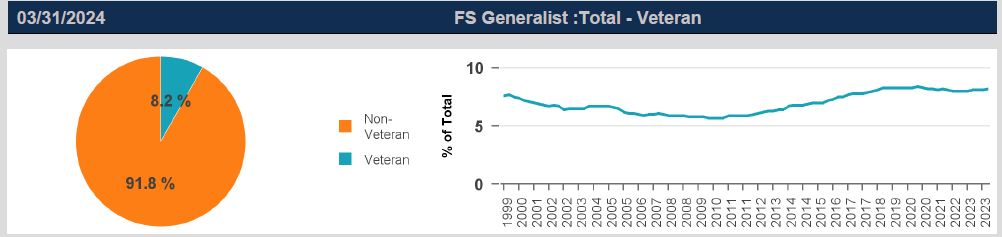
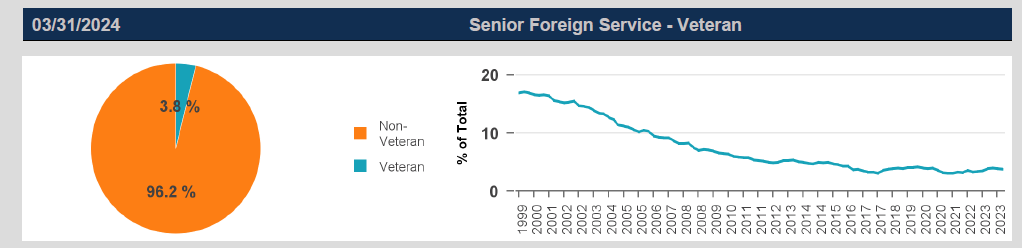
The data portrayed in these graphs paints a grim picture of the career prospect facing veterans within the Foreign Service. While this SFS data is not explicitly broken down between Generalists and Specialists and it may not be an exact comparison, the data nevertheless presents a clear and troubling picture.
A Second Indicator: Senior Leader Biographies
To add further texture to this data, I undertook a further statistical sampling by looking at the public biographies of key leaders within State regional bureaus. These bios included the Front Offices within each bureau, as well as those biographies for its posts’ Ambassadors, DCMs, Consul Generals, and principal officers. The results - which reflect entries as of January 2023 and again in January 2024 - indicate the obstacles facing veterans within the Foreign Service Generalist field may be even more troubling than the raw data on the GTM Diversity Trends site would imply:
Figure 3: Senior Level Veterans by Regional Bureau as of January 1st:
Bureau | Total Senior Ldr Bios | # of Veterans | Percentage
African Affairs (AF):
2023 | 85 | 0 | 0%
2024 | 84 | 1 | 1.2%
East Asian and Pacific Affairs (EAP):2023 | 63 | 3 | 4.7%
2024 | 65 | 1 | 1.5%
Europe and Eurasian Affairs (EUR):2023 | 95 | 2 | 2.1%
2024 | 95 | 2 | 2.1%
Near East Asian Affairs (NEA):2023 | 37 | 3 | 8.1%
2024 | 41 | 3 | 7.3%
South and Central Asian Affairs (SCA):2023 | 31 | 0 | 0%
2024 | 33 | 0 | 0%
Western Hemisphere Affairs (WHA):2023 | 62 | 3 | 4.8%
2024 | 65 | 5 | 7.7%
Total:2023 | 373 | 11 | 2.9%
2024 | 383 | 12 | 3.1%
This data was collected by reading posted bios and searching for mentions of military service. Admittedly, this is not a perfectly scientific sample as it relies on self-reporting, but it is to my knowledge the only such data available. In my experience, furthermore, FSOs will usually mention any military service in their official biographies. I excluded political appointees unless they were either FS retirees or officials who had previously served as career Foreign Service Officers at some point in their lives. I was as inclusive as possible in defining a veteran from these bios: I did not distinguish between enlisted or officer service, nor between service in the active or reserve components, nor did I attempt any further characterization (i.e. combat versus peacetime) of their listed service. If the individual identified themselves as a veteran, I counted them as one. This data is only as valid as the underlying information within the biography, and it is possible that some leaders may for some reason have excluded their military service from their entry.
At the same time, though, not all the positions in Table 3 are actually SFS ranks. Many DCM and other senior positions are filled by FS-1 and FS-2 officers and some others are filled by mid-level officers in an acting capacity. It was clear from context of the bios that at least 5 to 8 of the 11-12 veterans listed each year were almost certainly not SFS officers. They are in some cases, for example, principal officers at various smaller posts. Even allowing for this, however, the selection for these leadership jobs (even on an interim basis) would seem to be a valid proxy to indicate preparation for positions of increased responsibility.
The available data would seem to indicate that veteran status is a significant career impediment at every level for FS Generalists. According to a 2021 speech by then-Deputy Secretary of State for Management and Resources McKeon, about 12-15% of incoming A100 classes are veterans; that number drops to about 8% across the overall generalist ranks, however. Veterans ascend into the SFS at a rate that is less than half that of their non-vet mid-level counterparts. As the chart shows, furthermore, even veterans who pass that narrow aperture into the SFS are underrepresented within many of our most important leadership roles within the Department.
This information set also helps pinpoint some of the problems that vets face within the Department. Perhaps the most important tentative lesson we can draw is that recruiting does not appear to be the main issue for generalists; the problems lie instead with promotion and retention. The GTM Dashboard also indicates that veterans are recruited into the FS Specialist and Civil Service positions in good numbers, but, like the FSO cohort, a disproportionately lower number reach senior rank. The differences for these groups are not as stark as they are for FS Generalists, however. The implications of these graphics are unambiguous: The challenges for Generalist vets are not confined to any administration, any bureau, or any set of Department leaders. Instead, it would seem to point to a pervasive cultural and institutional trend that has extended across multiple changes in leadership.
A Third Indicator: GAO’s 2020 Study
This research above strongly is strongly corroborated by the findings of a January 2020 Government Accounting Office (GAO) study State Department: Additional Steps Are Needed to Identify Potential Barriers to Diversity. Though that study was primarily designed to study obstacles to advancement based on race, ethnicity, or gender, the statistical tabulations within this study showed that employees with a veteran’s preference significantly correlated with a lower chance of promotion from the grade of FS03 through the senior ranks -- in some cases upwards of 30-45% annually (Tables 38-43). According to the GAO regression analysis, veteran status was more of a negative discriminator than nearly any other factor, including race and gender. For some models, in fact, a veterans’ preference hurt an employee’s chance of promotion more than a prolonged absence or period of Leave Without Pay (LWOP) in the previous year.
It is worth noting that the 2020 GAO study is itself an imperfect product because it does not distinguish between Generalists and Specialists. That being said, however, the Department concurred with its recommendations and then apparently chose not to further disaggregate data sets between Generalists and Specialists and run the statistical models again, as it easily could have done.
Both AFSA and the Department appear to have adopted somewhat contradictory responses to this GAO study. AFSA cited the promotion data for minority officers to urge the Department to strengthen its mentorship programs for these employees, but it assiduously avoided engaging on veteran issues and promotions, despite the same GAO product demonstrating that a veteran’s preference generally has more pronounced negative effect than that of minority status (though, in all fairness, we should note that the GAO Report itself made no recommendations addressing veteran issues, despite the stark results of their own regression analysis.)
Given the unfortunate failure to differentiate between Generalists and Specialists and the general challenge of correlation versus causation, we could be cautious about using the GAO study as a dispositive or stand-alone product. That being said, the GAO itself urged the Department to undertake further statistical study to identify barriers to diversity. Despite the worrying initial data presented on veteran advancement and retention in the GAO paper and the Department’s concurrence with its recommendations, the Department did essentially nothing in response to it (although we should note that the Department has established a Veterans’ Support Program and strengthened its veteran hiring programs.)
What the Data Means
We have presented three indicators, each pointing to a significant problem with veteran career progression within the Foreign Service: the GTM Dashboard data, the study of key leader bios by regional bureau, and the 2020 GAO study. None of these products are perfect by any means, but each of these three pieces of evidence broadly corroborate each other and each point to a serious issue within the Department.
Unpacking the GTM data further, we see some other significant anomalies. As we can see in Figure 2, on 9/11/2001, almost 17% of Senior Foreign Service Officers were veterans. Today’s 3.8 % total reflects a roughly 80% decline in the proportion of senior diplomats with military experience. This represents a profoundly counterintuitive institutional response to an era of complex and multifaceted conflict, especially with the litany of complaints about substandard State-Defense cooperation in those years voiced by both sides of the discussion. Put simply, had the Department of State deliberately sought over the last twenty years to purge its senior ranks of officers with military experience, it could hardly have done so more effectively than it did.
Had the interagency turned in a strong, well-coordinated performance in our various conflicts over the last twenty years, such an incongruity would be less salient. The reality, however, is that our whole-of-government effort left much to be desired. Questions of specific policies aside, our role with the Defense Department (and others) was marked by poor synchronization of effort, misaligned priorities, and – all too often – a vast gulf of misunderstanding between the two organizations. Results of this interagency disconnect have ranged frankly from suboptimal at best to disastrous at worst. It seems that even as we sought to expand our role with Political Advisor (POLAD) representation in various commands, combat unit staffs, PRTs, and the like, we were unwittingly pushing out many of our personnel best equipped to work with our military and other interagency counterparts. This need for State-Defense cooperation has not changed with the shift in emphasis from counterterrorism/counter-insurgency to great-power competition. In fact, it may be even more acute.
The data I present should raise serious concerns about reputational (and perhaps even legal) exposure within the Department. While I am not a lawyer or expert in labor law, these trends would seem to present a reasonable prima facie case for employment discrimination. This is especially true as the Department’s foreign service promotion boards rarely, if ever, explain their decisions and their choices cannot be grieved except for narrow procedural violations. At a minimum, this presents a terrible optic for the Department before a country that, for all its stark divisions on other matters, loves and honors its veterans. I can say, however, that this data validates the lived experiences of a veteran community that often feels misunderstood and alienated within the Department. If this were any other category of employees, we would undoubtedly seek to explain and redress the discrepancies laid bare by GTM’s data.
A Broader Context
Ultimately though, State’s treatment of its work force is more than a question of avoiding legal hazards or negative media attention. It is a reflection of our values and our goals as an institution. The Department’s Office of Diversity Initiatives (ODI) does not specifically discuss veteran status in its public facing literature, perhaps because no one could have envisioned the statistical gap between vets and non-vets that we now see emerging. ODI, in fact, ignored multiple emails seeking their response to various versions of this paper (evidently the diversity pantheon did not include veterans…) In light of the issues raised by the GAO study and GTM’s own statistics, however, I think that analyzing this achievement gap can help both veterans and non-veterans, and perhaps permit us to draw out portable concepts that we can apply elsewhere in our efforts to build a productive and fulfilling workplace.
In this context, the United States military is a stunningly successful example of the power of an organization of varied origins united by a common mission and high standards. Whether judged by ethnicity, national origin, religious faith, geographical region of birth, socio-economic status, or differing perspectives and opinions, we would be hard pressed to identify a source of employees that encompasses a more robust gamut of people than our armed forces. The sight of a black officer or senior enlisted member giving orders to a junior white male service member is today so routine that it escapes our everyday notice – and it has been this way for over seventy-five years. Driven by a shared sense of purpose and a commitment to excellence, the armed forces have been among the rare institutions where merit held sway.
A better understanding of the challenges that vets face could have significant payoffs in building a better performing and higher morale workplace. Specifically, it may offer us insights into the elusive issue of organizational culture.
Institutional Bias and Institutional Indifference
I first presented a portion of this research in early 2023 to various offices within the Department and to AFSA. At that point, I would have asserted that the discrepancies outlined in this paper were not the result of any personal animus against veterans, but rather the consequence of unconscious bias driven by organizational dynamics and institutional norming. A year on, however, I would modify that view somewhat. I believe that at the individual employee level, our non-veteran colleagues would reject any accusation that they have consciously discriminated against veterans, and, in my experience, they would be generally right to do so. While vets may have encountered occasional manifestations of open hostility, I think that most would agree that this is the exception.
With the passage of almost two years, however, I am less inclined to offer the Department as an institution the same dispensation. The 2020 GAO study highlighted the existence of a meaningful and consequential issue with veteran career progression almost four years ago, yet the matter had little apparent resonance with our leadership. Last year, different versions of this paper were presented to - and reportedly read by – key leaders within GTM, ODI, the DG’s Office, seventh floor principals, and AFSA. My intent was to air this internally within the Department in order to offer our leadership a chance to address it in a calm, studied, and discreet manner.
The response has been, somewhat to my surprise, almost complete silence. Not one office or leader offered meaningful engagement on the material presented, nor could any written response to me make it through internal clearance processes within our building. An unconscious bias is a predilection that one is not actually aware of: If a matter is brought to a person’s or organization’s attention and they still take no action to address or resolve it, we can frankly no longer describe it as “unconscious.” This is where the Department finds itself today.
I think the real issue here is not one of individual belief or conduct, but rather one of institutional behavior, which, in all likelihood, makes it devilishly difficult to address. My personal belief is that if we were to further unpack this issue, we will find that some of these problems will come back to differences in work culture. As discussed in a seminal, and prescient, 1998 paper jointly authored by an FSO and an Army officer, “Defense Is From Mars, State is From Venus: Improving Communications and Promoting National Security,” DOD and State have profoundly different organizational norms and standards. Veterans often bear the indelible mark of an overwhelmingly powerful military experience in their formative early adult years (usually quite positive, though sometimes definitely not.) Even as we modify our behaviors to better accommodate the civilian institutional culture around us, these experiences remain embedded and they shape perceptions of what “right looks like” for veterans in the workplace.
The cost of veterans stalling out on the career ladder is deeply felt within this organization – and very much to the Department’s detriment. Veterans are the scions of a professional culture that values and prioritizes individual training and development, adaptability, advanced planning, personal integrity, and the subordination of individual interests to the broader mission. Veterans expect supervisors to uphold standards, make clear and timely decisions, accept responsibility for their actions, and demand accountability at all levels. They expect those in authority to lead first and foremost by example. Based on a variety of surveys and professional exchanges, these are, perhaps ironically, also attributes and values that many of our frustrated State colleagues – veteran and non-veteran alike – find to be in short supply across the Foreign Service. The institutional culture of the veteran employee may be a little different than that of this Department, but it may carry some of what this institution needs to succeed in a complex future operational setting.
We should also acknowledge that our current leadership model is not working. The effective closing of senior ranks to veterans has coincided with a widespread perception among the workforce of deteriorating leadership across the Department, regardless of Administration. During the same time frame which the State Department essentially purged itself of SFS leaders with military experience, we have also witnessed the collapse of employee morale across the Department in annual Federal Employment Viewpoint Surveys. In 2012, the State Department ranked 3rd of 17 large organizations in employee satisfaction; by 2023, we had fallen to 15th of 17. Whether it is question of causality or correlation or one of cause versus effect – i.e. whether poor leaders are driving out veterans or whether leadership within the Department has declined in part due to the attrition of veteran officers with greater leadership experience - there is no positive spin on this convergence of two uncomfortable realities.
The unnecessary attrition of this unique body of Foreign Service professionals may undermine policy formation and analysis as well. Veterans are vastly overrepresented among the officers we call upon in times of crises, as evidenced by the prominent role FSO veterans played in the Afghanistan evacuation, the Ukraine crisis, and elsewhere. Yet, on a day-to-day basis, FSO veterans will anecdotally report that they often feel somewhat marginalized and out of step with an intellectual monoculture in the Department that shuns prioritization and tough choices, privileges vapid rhetorical “feel goodery” over hard-nosed analysis of U.S. interests, and – perhaps above all – avoids personal or policy risk at all costs. This is not to suggest that more veterans in our senior ranks would have miraculously cured our organizational woes, but it does seem reasonable to suggest that this de facto purge of veterans from our leadership has certainly not alleviated the problems we face.
Veterans come from a culture that stresses several principles, among them clear lines of authority and responsibility, teamwork, and specific individual and collective training to build effective groups and organizations. The veteran culture demands that its members function both as part of a team and as leaders of teams, and it carries an expectation that the distribution of assignments and promotions should be based both on merit and the attainment of specific professional prerequisites of experience, certification, or training. A relentless individual focus on skill-building, accreditations, and personal improvement is directly tied to eligibility for future assignments.
The advantages and disadvantages of such a culture applied to the State Department are beyond the scope of this paper. Some aspects of military culture are occasionally honored in the breach and military professional journals regularly and vigorously debate how well this culture works for DOD, and the degree to which DOD lives up to its own principals. What is indisputable is that the State Department, as an institution, does not have a culture of training, self-development, and accountability. From time to time, individual offices or bureaus may approach aspects of it, but this is a function of individual leaders, and it rarely survives their inevitable rotation.
To reiterate, I do not feel that the issues outlined in this paper reflect a personal animus against veterans on the part of our colleagues; I believe that is a question of organizational and cultural biases. In some ways, though, cultural factors provide the most pessimistic explanation for the data presented here: Deliberate individual discrimination can be countered by dealing with the offending persons. Institutional biases are more amorphous and more difficult to identify, and therefore more challenging to redress.
Suggesting a Path Forward
The data embedded within the GAO Study, the GTM Dashboard, and our survey of regional bureaus is stark, and it probably defies easy explanation. I would suggest the following, however, as a series of first steps to formulate an institutional response:
• Check my work: I have drawn my data directly from GTM and from other State official sources, but I should note that, as veteran myself, I have a personal stake in this issue. I urge interested parties to examine the data as well, and to pull out – and share - any analytical blind spots that I might bring to this problem set.
• Build the data sets we need: These data points in this paper are not perfect, and they do not in all cases provide the precise “apples to apples” comparisons that we would like. Based on our response to the GAO study, though, it seems as though DOS would sometimes prefer to dismiss an imperfect data set that points to an uncomfortable conclusion rather than to take the next step and get the data that would provide a conclusive – if inconvenient - answer. This is a cop out unworthy of a serious organization.
• Don’t Wish Away the Problem: Assuming this data is correct, it paints a deeply negative picture of how this Department deals with those who have served this country in uniform. Not addressing this issue risks further alienation of our veteran workforce and it presents the Department in a profoundly unfavorable public light.
• Reject Convenient or Facile Explanations. Example: “vets don’t ascend into the SFS because they TIC or TIS out at mandatory retirement beforehand.” While perhaps true of those who have served a full career in the military, the average vet is probably not much older than the average non-vet when entering A100 (usually early to mid-thirties), and the median time to achieve SFS rank is about 20.2 years. “The clock” is not what is keeping the Department’s veterans from reaching senior positions.
• Engage significant stakeholders and veteran focus groups: This would probably include the Veteran Support Program, AFSA, GTM, and other offices. Though the data alone shows that there is a problem, we will not fully understand it until we talk to the impacted employees.
• Consider formation and recognition of military reservist community of interest within the Department. This group could help address the specific challenges inherent on synchronizing reserve requirements and opportunities to better align our objectives and better use this extraordinary asset within the FS.
Footnotes:
Secretary Blinken twitter message, 11 November 2022. https://twitter.com/SecBlinken/status/1591047540706889730.
Source for Both: GTM Diversity Trends, GTM Knowledge Center.
Cited from D-MR remarks at Veterans Day event at the Harry S Truman Building, Washington DC, 16 November 2021.
GTM Diversity Trends, GTM Knowledge Center.
Government Accounting Office (GAO), State Department: Additional Steps Are Needed to Identify Potential Barriers to Diversity. Published 27 January 2020. https://www.gao.gov/products/gao-20-237.
Ibid
LTC Rickey L. Rife, USA, and Rosemary Hansen, FSO, “Defense Is From Mars, State is From Venus: Improving Communications and Promoting National Security,” U.S. Army War College (1 June 1998).
Richard Hinman is a Foreign Service Officer and a retired US Army Lieutenant Colonel. In addition to Washington DC, Rich has served in Prague, Chennai, Amman, Tunis, Moscow, and Kabul and he was a Weinberg Fellow at Princeton University.